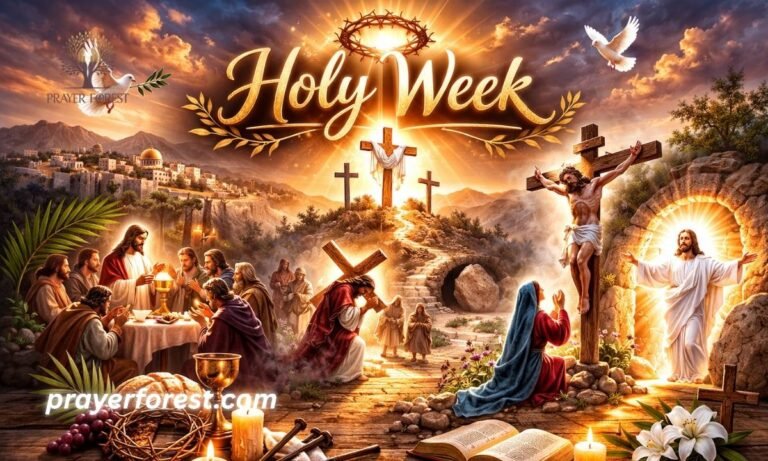
Every year, millions of Christians around the world enter into the most sacred season of their faith — Holy Week. Whether you are a lifelong believer, someone returning to the church after years away, or simply curious about the story behind Easter, this guide will walk you through every single day of Holy Week 2026 with clarity, depth, and reverence.
Holy Week begins on Palm Sunday and ends on Holy Saturday, culminating in the celebration of Easter Sunday. In 2026, Holy Week runs from March 29 through April 4, with Easter Sunday falling on April 5, 2026.
This complete guide covers what happens each day, the biblical scripture behind each event, the spiritual meaning behind the traditions, and how Christians around the world observe these holy days today.
What Is Holy Week? A Quick Overview
Holy Week is the final week of Lent and the most important week in the Christian calendar. It commemorates the last days of Jesus Christ’s earthly life — from his triumphant entry into Jerusalem to his crucifixion, death, burial, and resurrection.
The week is observed by Roman Catholics, Eastern Orthodox Christians, Anglicans, Lutherans, Methodists, and many other Protestant denominations. While the specific rituals and liturgies vary by tradition, the core narrative remains the same: the Passion of Christ.
The word “Passion” in this context comes from the Latin passio, meaning suffering. The Passion of Christ refers specifically to the suffering and death of Jesus, and Holy Week is the Church’s annual remembrance and re-living of those events.
Holy Week 2026 Dates at a Glance
| Day | Date | Event |
| Palm Sunday | March 29, 2026 | The Triumphal Entry into Jerusalem |
| Holy Monday | March 30, 2026 | The Cleansing of the Temple |
| Holy Tuesday | March 31, 2026 | Jesus Teaches in the Temple Courts |
| Holy Wednesday (Spy Wednesday) | April 1, 2026 | Judas Agrees to Betray Jesus |
| Maundy Thursday | April 2, 2026 | The Last Supper & Institution of the Eucharist |
| Good Friday | April 3, 2026 | The Crucifixion and Death of Jesus |
| Holy Saturday | April 4, 2026 | The Day in the Tomb — Silence and Waiting |
| Easter Sunday | April 5, 2026 | The Resurrection of Jesus Christ |
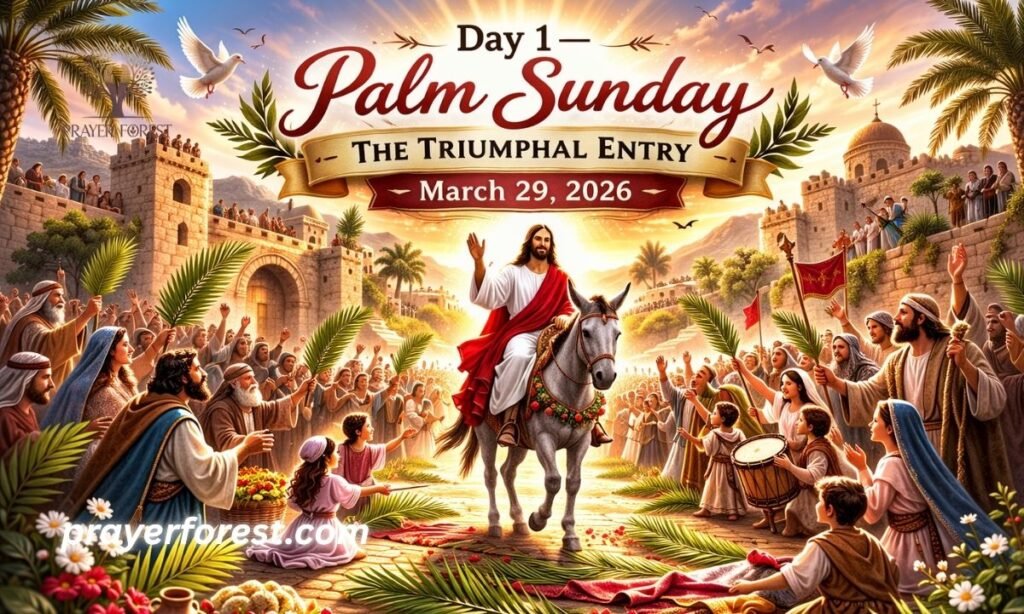
Day 1 — Palm Sunday, March 29, 2026: The Triumphal Entry
What Happened on Palm Sunday?
Holy Week begins with one of the most visually striking events in the Gospels. Jesus rode into Jerusalem on a young donkey, and the crowds lined the road, laying down their cloaks and palm branches in front of him, crying out “Hosanna! Blessed is he who comes in the name of the Lord!” (Mark 11:9).
This moment was rich with prophetic fulfillment. The prophet Zechariah had written centuries earlier about a king who would come “righteous and victorious, lowly and riding on a donkey” (Zechariah 9:9). By entering on a donkey rather than a war horse, Jesus presented himself as a king of peace — not a military conqueror.
“Blessed is he who comes in the name of the Lord! Hosanna in the highest heaven!” — Matthew 21:9
Spiritual Meaning of Palm Sunday
Palm Sunday sets up the central irony and tragedy of Holy Week. The crowds who cheered Jesus into Jerusalem would, within days, be calling for his crucifixion. This sobering reality invites believers to examine their own fidelity — how quickly devotion can turn to abandonment when things become difficult.
The palm branch itself was a symbol of victory and triumph in the ancient world. By welcoming Jesus with palms, the crowd was effectively crowning him king — though not in the way they expected. Jesus did not come to overthrow the Romans. He came to overthrow sin and death.
How Palm Sunday Is Observed Today
Churches across the world distribute palm branches to worshippers, who carry them in procession. The blessed palms are often kept in homes throughout the year, and in many traditions, last year’s palms are burned to create the ashes used on Ash Wednesday the following year — a beautiful cycle of remembrance and renewal.
Day 2 — Holy Monday, March 30, 2026: The Cleansing of the Temple
What Happened on Holy Monday?
The day after his triumphal entry, Jesus returned to Jerusalem and went to the Temple. What he found there filled him with righteous indignation. The outer courts of the Temple — meant to be a place of prayer for all nations — had been turned into a marketplace. Money changers and merchants selling animals for sacrifice had commercialized the most sacred space in Judaism.
Jesus overturned the tables of the money changers and drove out those who were buying and selling, declaring: “It is written, ‘My house will be called a house of prayer,’ but you are making it a den of robbers.” (Matthew 21:13).
“My house will be called a house of prayer, but you are making it a den of robbers.” — Matthew 21:13
Spiritual Meaning of the Temple Cleansing
This bold, provocative act in the very heart of religious power in Jerusalem was a direct challenge to the religious establishment. It was this moment, more than any other, that crystallized the determination of the chief priests and scribes to arrest and kill Jesus (Mark 11:18).
Spiritually, the cleansing of the Temple invites reflection on the integrity of worship. Are we approaching God authentically, or have we allowed our faith to become transactional, performative, or distorted by worldly priorities?
Day 3 — Holy Tuesday, March 31, 2026: Teaching in the Temple
What Happened on Holy Tuesday?
Holy Tuesday was perhaps the most intellectually and theologically charged day of Holy Week. Jesus returned to the Temple courts and engaged in a series of intense debates with religious leaders who were determined to trap him with his own words.
The Pharisees tried to trick him on the question of paying taxes to Caesar (Matthew 22:15–22). The Sadducees challenged him about the resurrection (Matthew 22:23–33). The scribes tested him about the greatest commandment (Matthew 22:34–40). In each case, Jesus responded with such wisdom that his questioners were silenced.
It was also on this day that Jesus delivered some of his most powerful teachings — the Parable of the Ten Virgins (Matthew 25:1–13), the Parable of the Talents (Matthew 25:14–30), and his famous Olivet Discourse: a sweeping prophecy about the end of the age and the coming of the Son of Man (Matthew 24–25).
“Love the Lord your God with all your heart and with all your soul and with all your mind. This is the first and greatest commandment.” — Matthew 22:37–38
Spiritual Meaning of Holy Tuesday
Holy Tuesday challenges believers to think deeply about their faith. Jesus’s responses to the religious leaders demonstrate that authentic faith is never threatened by hard questions — it is strengthened by them. His teachings on the end times remind us to live with urgency, faithfulness, and love.
Day 4 — Holy Wednesday (Spy Wednesday), April 1, 2026: The Betrayal Is Planned
What Happened on Holy Wednesday?
Holy Wednesday is sometimes called “Spy Wednesday” — a name that captures the dark nature of this day. It was on this day that Judas Iscariot, one of Jesus’s twelve chosen disciples, went to the chief priests and offered to betray his master for thirty pieces of silver (Matthew 26:14–16).
This fulfilled the ancient prophecy of Zechariah: “So they paid me thirty pieces of silver” (Zechariah 11:12). The amount — thirty shekels — was the price of a slave under Old Testament law, a detail that speaks volumes about how the religious establishment valued Jesus.
“Then one of the Twelve — the one called Judas Iscariot — went to the chief priests and asked, ‘What are you willing to give me if I deliver him over to you?'” — Matthew 26:14–15
Spiritual Meaning of Spy Wednesday
The betrayal of Judas has haunted Christian imagination for two thousand years. Whatever his motives — greed, disillusionment, or a misguided attempt to force Jesus to reveal himself as a political messiah — Holy Wednesday invites honest self-examination. The Gospels suggest that the capacity for betrayal does not lie only in the heart of Judas — it lives in each of us. Every time we choose comfort over faithfulness, convenience over truth, or self-interest over love, we echo in some small way the choice Judas made.
Day 5 — Maundy Thursday, April 2, 2026: The Last Supper
What Happened on Maundy Thursday?
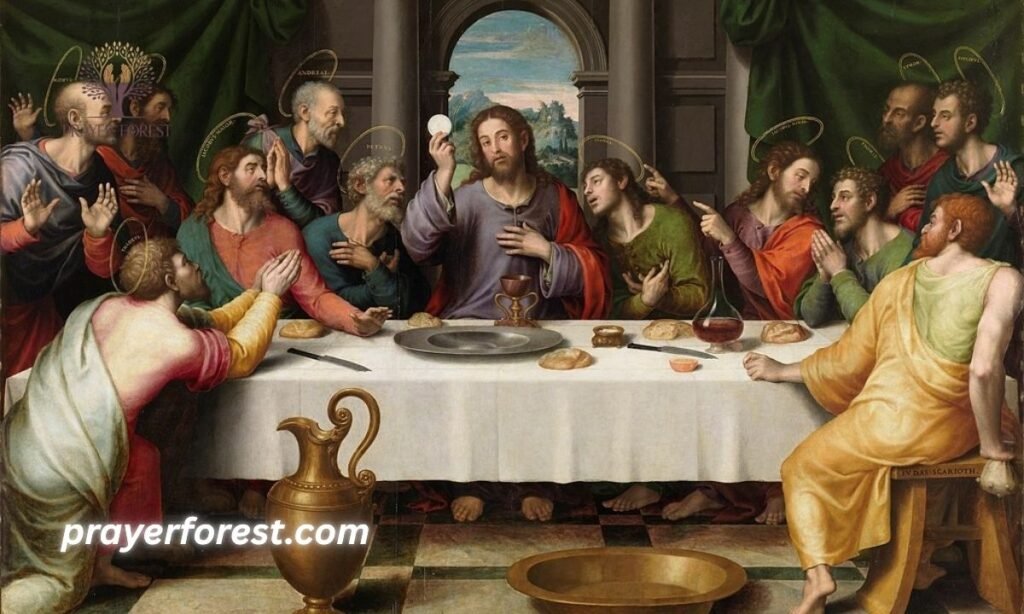
Maundy Thursday is one of the most theologically dense days in the entire Christian year. On this night, Jesus gathered his twelve disciples in an upper room in Jerusalem to celebrate the Passover meal together. What unfolded over the course of that evening would become the foundation of Christian sacramental worship for all time.
The evening began with an act of shocking humility: Jesus took off his outer garments, wrapped a towel around his waist, and washed the feet of each of his disciples — a task reserved for the lowest servants (John 13:1–17). When Peter protested, Jesus said: “Unless I wash you, you have no part with me.”
Then Jesus took bread, gave thanks, broke it, and gave it to his disciples, saying: “This is my body, which is given for you. Do this in remembrance of me.” In the same way, he took the cup of wine after supper, saying: “This cup is the new covenant in my blood, which is poured out for you.” (Luke 22:19–20). The Eucharist — the central act of Christian worship — was born in that upper room.
“A new command I give you: Love one another. As I have loved you, so you must love one another.”— John 13:34
What Does “Maundy” Mean?
The word “Maundy” comes from the Latin mandatum, meaning “commandment.” It refers to the new commandment Jesus gave his disciples at the Last Supper: “Love one another as I have loved you.” This is the heart of Christian ethics — not a set of rules, but a call to radical, self-giving love modeled on Christ himself.
The Garden of Gethsemane
After the meal, Jesus led his disciples to the Garden of Gethsemane on the Mount of Olives. There, in one of the most agonizing moments in the Gospels, Jesus prayed: “Father, if you are willing, take this cup from me; yet not my will, but yours be done.” (Luke 22:42).
Three times he returned to find his disciples sleeping. Then came the sound of soldiers and torchlight — and Judas leading them to the one man he had promised to betray with a kiss.
How Maundy Thursday Is Observed Today?
Many churches hold a special liturgy that includes a re-enactment of the foot-washing, a celebration of the Eucharist, and often a stripping of the altar — removing all decorations, candles, and coverings in preparation for Good Friday. Many communities hold an all-night watch in remembrance of Jesus’s night of prayer in Gethsemane.
Day 6 — Good Friday, April 3, 2026: The Crucifixion
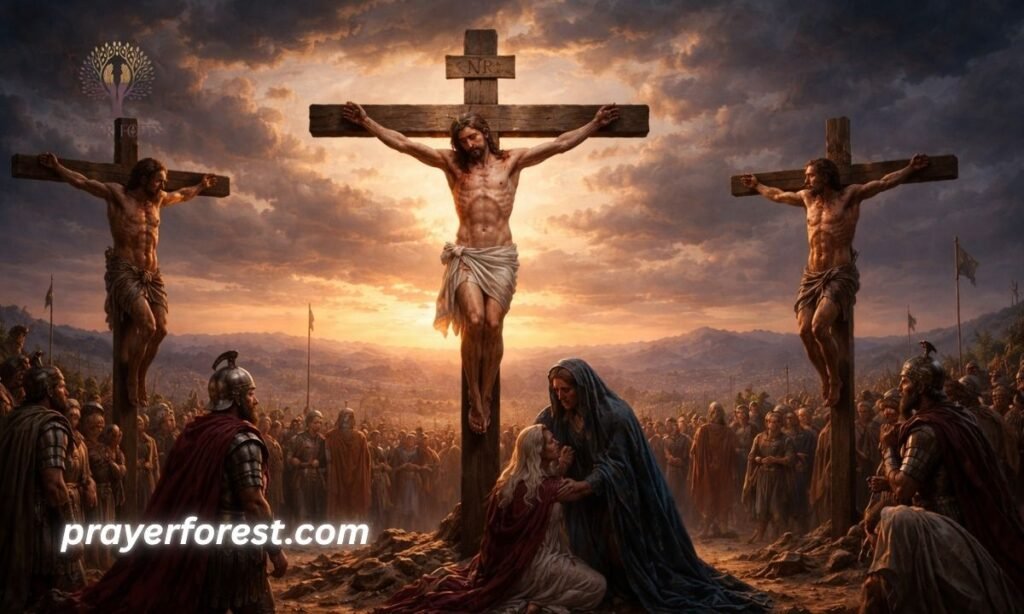
Why Is It Called “Good” Friday?
To those hearing the name for the first time, “Good Friday” can seem strange — even contradictory. This is the day Jesus was tortured and executed. What is good about that?
The “good” in Good Friday is understood in the older sense of the word — holy, or sacred. For Christians, it is “good” in the deepest theological sense: it was through the cross that salvation was accomplished for all humanity.
What Happened on Good Friday?
The events of Good Friday unfolded with terrible speed. After his arrest in Gethsemane, Jesus was taken to the high priest Caiaphas, then to Pontius Pilate, the Roman governor. Pilate found no guilt in Jesus but, under pressure from the crowd and the religious leaders, ordered his crucifixion.
Jesus was flogged — a brutal punishment that often left victims near death — then forced to carry his own cross through the streets of Jerusalem to Golgotha, “the Place of the Skull.” There, at nine in the morning, he was nailed to the cross between two criminals.
For six hours he hung on the cross. At three in the afternoon, Jesus died. The Gospel of Matthew records that at the moment of his death, the curtain of the Temple was torn in two from top to bottom — a dramatic symbol that the barrier between God and humanity had been removed forever.
“Father, forgive them, for they do not know what they are doing.” — Luke 23:34
The Seven Last Words of Christ
- “Father, forgive them, for they know not what they do.” — Luke 23:34
- “Today you will be with me in paradise.” — Luke 23:43
- “Woman, here is your son… Here is your mother.” — John 19:26–27
- “My God, my God, why have you forsaken me?” — Matthew 27:46
- “I am thirsty.” — John 19:28
- “It is finished.” — John 19:30
- “Father, into your hands I commit my spirit.” — Luke 23:46
How Good Friday Is Observed Today?
Good Friday is traditionally the most solemn day of the Christian year. Many churches hold a three-hour service from noon to 3:00 PM in remembrance of the hours Jesus hung on the cross. The Stations of the Cross are observed in Catholic and many Anglican and Lutheran churches. In many countries, Good Friday is a public holiday. Church bells fall silent. The altars remain stripped bare.
Day 7 — Holy Saturday, April 4, 2026: The Great Silence
What Happened on Holy Saturday?
Holy Saturday is, in many ways, the most neglected day of Holy Week — and perhaps the most profound. It is the day of silence. The day between death and resurrection. Jesus lay in the tomb, sealed with a great stone, guarded by Roman soldiers.
The disciples were scattered, terrified, and grief-stricken. Everything they had believed, everything they had hoped for, seemed to have died on the cross with Jesus. For them, Saturday was not a day of waiting — it was a day of despair.
The Gospel narratives record little of Holy Saturday’s events. Luke simply notes: “On the Sabbath they rested according to the commandment.” (Luke 23:56). This silence is itself meaningful.
The Theology of Holy Saturday
Christians believe that while Jesus’s body lay in the tomb, something extraordinary was happening in the spiritual realm. The Apostles’ Creed states that Jesus “descended into hell” — a cryptic phrase that has generated centuries of theological reflection. The most common interpretation is that Jesus, in his death, entered into the full depth of human experience to bring the light of redemption to all who had died before his coming.
The Easter Vigil
The most ancient and dramatic liturgy of the Christian year begins on Holy Saturday night. Believers gather in darkness. A great fire is kindled, and from it the Paschal Candle — symbolizing the risen Christ — is lit. The congregation processes into the church in darkness as the deacon chants the ancient Exsultet, a hymn of praise sung at the Easter Vigil since at least the fourth century. The first Alleluia since Ash Wednesday rings out. The long fast is over.
Easter Sunday, April 5, 2026: The Resurrection
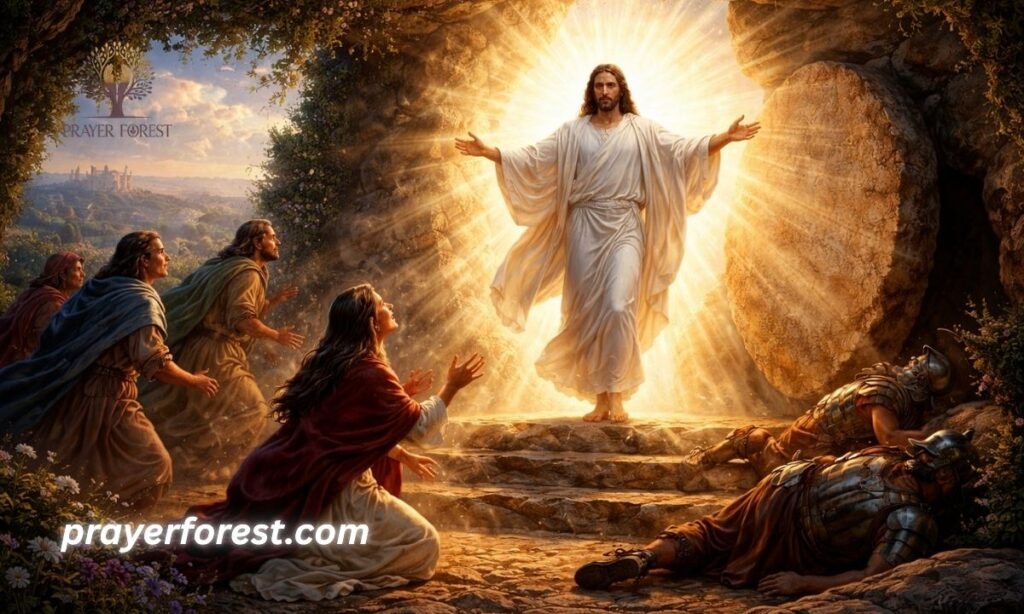
Though technically the first day of the week following Holy Week, no account of Holy Week is complete without Easter Sunday. On the morning of the third day after his crucifixion, Jesus rose from the dead. The stone was rolled away. The tomb was empty. The angels announced to the women who came to anoint his body: “He is not here; he has risen!” (Luke 24:6).
Easter Sunday is the cornerstone of Christian faith. As the Apostle Paul wrote: “If Christ has not been raised, your faith is futile.” (1 Corinthians 15:17). The resurrection is not merely a happy ending to a sad story — it is the event upon which the entire Christian understanding of God, humanity, and salvation rests.
“He is not here; he has risen, just as he said.” — Matthew 28:6
Key Scriptures for Every Day of Holy Week
| Day | Key Bible References |
| Palm Sunday | Matthew 21:1–11 · Mark 11:1–11 · Luke 19:28–44 · John 12:12–19 |
| Holy Monday | Matthew 21:12–17 · Mark 11:15–19 · Luke 19:45–48 |
| Holy Tuesday | Matthew 21:23–23:39 · Mark 11:27–13:37 · Luke 20–21 |
| Spy Wednesday | Matthew 26:6–16 · Mark 14:3–11 · Luke 22:3–6 |
| Maundy Thursday | Matthew 26:17–75 · Mark 14:12–72 · Luke 22:7–62 · John 13–18 |
| Good Friday | Matthew 27:1–66 · Mark 15:1–47 · Luke 23:1–56 · John 18:28–19:42 |
| Holy Saturday | Matthew 27:62–66 · Luke 23:56 |
| Easter Sunday | Matthew 28 · Mark 16 · Luke 24 · John 20–21 |
Holy Week Across Christian Traditions
Roman Catholic: The Sacred Triduum — Holy Thursday evening through Easter Sunday — is considered the high point of the entire liturgical year, with elaborate ancient liturgies for each day that have remained largely unchanged for centuries.
Eastern Orthodox: Orthodox Christians celebrate Holy Week with extraordinary candlelit services of great beauty and length. In 2026, Orthodox Easter (Pascha) falls on April 12, one week after Western Easter. The service of the Twelve Gospels on Holy Thursday and the Lamentations service on Holy Saturday are particularly beloved.
Protestant: Observance varies widely. Anglican, Lutheran, and Methodist congregations often follow liturgical traditions similar to the Catholic Church. Evangelical and non-denominational churches typically focus on Palm Sunday and Good Friday, with special attention given to Easter Sunday morning worship.
Why Holy Week Matters in 2026?
In a world that often moves too fast for reflection, Holy Week invites a radical slowing down. For seven days, Christians are asked to walk alongside Jesus — from the cheering crowds of Palm Sunday to the silence of Holy Saturday — before arriving at the joy of Easter.
Whether you observe every liturgy or simply attend one Good Friday service, whether you are a cradle Christian or someone exploring the faith for the first time, Holy Week offers something rare: a week-long invitation to wrestle with the deepest questions of human existence. Who is Jesus? What does his death mean? What does his resurrection change?
These are not merely religious questions. They are questions about love, sacrifice, justice, suffering, and hope — questions that every human being faces, in one form or another, across a lifetime.
Holy Week 2026 begins on March 29. There is no better time to begin.
Frequently Asked Questions About Holy Week 2026
When is Holy Week 2026?
Holy Week 2026 runs from Palm Sunday, March 29, through Holy Saturday, April 4. Easter Sunday is April 5, 2026.
What is the difference between Holy Week and Easter Week?
Holy Week refers to the week before Easter Sunday, covering the events of Jesus’s Passion, death, and burial. Easter Week (also called the Octave of Easter) refers to the eight days following Easter Sunday, during which the Church celebrates the resurrection.
Why does Easter change every year?
Easter is a “moveable feast” calculated based on the lunar calendar. Western Christianity follows the Computus, which sets Easter on the first Sunday after the first full moon following the spring equinox. This means Easter can fall anywhere between March 22 and April 25.
Is Good Friday a public holiday in 2026?
In many countries — including the United Kingdom, Australia, Canada, and several European nations — Good Friday is a public holiday. In the United States, it is not a federal holiday, though some states and many businesses observe it.
How do I start observing Holy Week if I’m new to it?
The simplest approach is to find a local church that offers Holy Week services and attend at least one — Palm Sunday or Good Friday are wonderful starting points. Reading the Passion narrative in one of the four Gospels alongside the calendar is also a deeply meaningful way to enter into the week.
Conclusion
Holy Week is not simply a religious observance. It is a journey — one that Christians have been making for two thousand years, walking the same narrative from triumph to tragedy to unspeakable joy.
Death is not the end. Betrayal and suffering do not have the final word. The stone can be rolled away.
He is risen. He is risen indeed.

Robert Hugh Benson shares inspiring Bible verses and faith-filled reflections on Prayer Forest to guide readers toward peace, hope, and prayer.