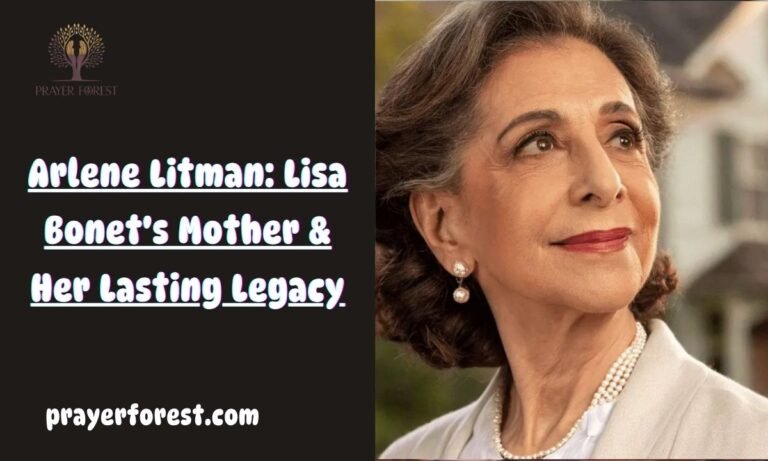
Behind every remarkable life there is often a quieter one that makes it possible. Arlene Joyce Litman never walked a red carpet, never gave a press interview, and never sought the kind of recognition the world so readily offered her famous daughter.
Yet without her — her courage, her music, her daily sacrifices, and her unconditional love — there may never have been a Lisa Bonet. Arlene’s story is one of the most quietly powerful narratives connected to Hollywood royalty.
A Jewish-American schoolteacher from Pittsburgh who chose love over tradition, raised a biracial daughter alone in the changing landscape of 1970s Los Angeles, and shaped a family tree that continues to produce extraordinary creative talent to this day.
Arlene Litman Quick Facts
| Detail | Information |
| Full Name | Arlene Joyce Litman |
| Date of Birth | February 11, 1940 |
| Birthplace | Pittsburgh, Pennsylvania, USA |
| Ethnicity | Ashkenazi Jewish (Polish and Russian roots) |
| Father | Eli Litman (1912–1986) |
| Mother | Sylvia Ellen Goldvarg (1916–2016) |
| Sibling | Barry Litman (brother) |
| Profession | Music Teacher / Schoolteacher |
| Husband | Allen Bonet (m. June 12, 1967; divorced) |
| Daughter | Lisa Michelle Bonet (born November 16, 1967) |
| Grandchildren | Zoë Kravitz, Lola Iolani Momoa, Nakoa-Wolf Momoa |
| Date of Death | March 3, 1998 |
| Place of Death | Los Angeles, California, USA |
| Cause of Death | Breast cancer |
| Age at Death | 58 years old |
Early Life
Arlene Joyce Litman was born on February 11, 1940, in Pittsburgh, Pennsylvania. Her parents were Eli Litman (1912–1986) and Sylvia Ellen Goldvarg (1916–2016). She grew up in a traditional Jewish household shaped by Eastern European immigrant values — discipline, education, community, and a deep respect for culture. Her family roots traced back to Poland and Russia, and those roots were woven into the fabric of daily life in Pittsburgh.
She had one sibling, a brother named Barry Litman, and the family shared a modest home together. Arlene grew up during a period of enormous historical change — born into the tail end of World War II, shaped by the social transformations of the 1950s, and entering adulthood precisely when the cultural revolutions of the 1960s began to reshape what American identity could look like.
Her family had Polish and Russian Jewish roots that shaped her early life and values deeply. Her parents identified as atheists, even though they came from a Jewish background — meaning they did not follow religion strictly, but still lived with the cultural traditions of their family. That combination of cultural identity without rigid religious practice would later inform the way Arlene raised Lisa — grounded in heritage, but fully open to the world.
Education and Teaching Career
Arlene developed a deep love for music from an early age, and that passion shaped the direction of her professional life entirely. She trained as a music teacher and dedicated her career to nurturing that love of sound in her students. She brought warmth, structure, and genuine passion to her classroom — qualities that her students reportedly remembered long after their time with her ended.
Teaching, for Arlene, was never simply a job. It was an expression of who she was — someone who believed in the power of education to open doors, build confidence, and give young people the tools they needed to find their own voice. Those same values she carried into motherhood with extraordinary and consistent dedication.
Meeting Allen Bonet: Two Worlds Collide

The story of Arlene Litman’s adult life turns significantly on a single, brave decision. Arlene Litman and Allen Bonet married on June 12, 1967, in San Francisco, California. The two were brought together by their shared love for music — while Arlene was a music teacher, Allen was an accomplished opera singer.
Allen Bonet was an African-American opera singer from Dallas, Texas — a man of considerable musical talent and artistic sensitivity. The connection between a Jewish schoolteacher from Pittsburgh and a Black opera singer from Texas was, in the racial climate of 1960s America, a deeply courageous one.
The union between the two was not a walk in the park. Arlene’s family was strongly against it. Her parents and her brother Barry did not accept her decision to marry an African-American man. However, she disregarded their objections and went on to marry Allen regardless. That decision cost her significantly in terms of family support — and it spoke volumes about the kind of woman she was. She chose love, principle, and her own conscience over the approval of those closest to her.
On November 16, 1967, they welcomed their daughter, Lisa Michelle Bonet. Lisa arrived just five months after their wedding — a child born into a marriage already navigating racial tension and family disapproval, but also filled with music, love, and two parents who shared a deep passion for the arts.
Motherhood and Life in Los Angeles
Bonet’s parents separated when Lisa was still a baby. The marriage between Arlene and Allen did not survive the pressures bearing down on it — family opposition, cultural differences, and the general demands of life in that era. Their divorce was finalized in 1969, just two years after Lisa was born.
What followed was one of the defining chapters of Arlene’s life. Alone, without family support from her side, and with minimal involvement from Allen after the divorce, Arlene settled in the San Fernando Valley community of Reseda and raised Lisa entirely by herself. She continued working as a teacher while nurturing Lisa’s natural creativity and independence. Reseda was a neighborhood known for its diverse population and strong sense of community — a place where a biracial child could grow with slightly more room to breathe than many other parts of the country offered at that time.
The life they built together was modest but rich in what mattered. Arlene kept the home filled with music — a natural extension of who she was professionally — and created an environment where Lisa felt free to explore, create, and become her own person. Arlene never became a controlling stage mother. She offered guidance without manipulation and celebration without jealousy.
A Single Mother’s Journey in a Changing America
To fully appreciate what Arlene Litman accomplished, it is essential to understand the context she was doing it in. Being a single white Jewish mother raising a biracial daughter in 1970s Los Angeles was not a simple social position. Arlene faced pressure from multiple directions simultaneously — estrangement from her own family, limited financial resources on a teacher’s salary, and the social challenges that came with raising a child who did not fit neatly into any single racial or cultural category.
Arlene’s own family made hurtful comments about Lisa not looking like a typical Jewish girl. But Arlene always stood firmly beside her daughter. She taught Lisa to stay confident, stay calm, and stay true to herself — lessons that would serve Lisa throughout one of the most scrutinized careers in 1980s and 1990s American television.
When Lisa expressed an interest in acting and began appearing in commercials at age eleven, Arlene supported her completely. Not by pushing or managing from behind the scenes, but by simply showing up, making the drives to auditions after long teaching days, and believing in her daughter consistently and without condition.
Influence on Lisa Bonet’s Life and Career
Lisa Bonet’s childhood under Arlene’s care shaped nearly everything about who she became as a person and as an artist. Bonet was close with her mom and was able to turn to her for help when times were tough, even well into adulthood. In one of her most quoted interviews, Lisa spoke about her mother simply: “She was a good woman. She loved me.”
Those eight words are among the most telling sentences Lisa has ever spoken publicly. They are not words of performance or obligation — they are words of genuine grief and gratitude from a woman who understood exactly what her mother had given her.
One powerful moment came in 1994, when a strong earthquake struck Los Angeles. Lisa and her young daughter Zoë Kravitz were left without a stable home. Arlene did not hesitate. She stepped in immediately, offering comfort and safety during an extremely difficult time. That single act encapsulates the nature of their bond — Arlene was always there, no matter what chapter Lisa was navigating.
The values Lisa has carried through her own life and parenting — a preference for privacy, a grounded approach to fame, a commitment to authenticity over conformity, and a deep connection to music and creativity — are all visible reflections of the environment Arlene created in that modest Reseda home.
Cultural Heritage and Identity
Arlene’s identity as an Ashkenazi Jewish woman with Eastern European roots was not something she set aside when she married Allen Bonet. It was part of who she was, and it became part of who Lisa is. Lisa Bonet has spoken throughout her career about the complexity and richness of her biracial identity — Black and Jewish, Californian and Southern, artistic and spiritual all at once.
Arlene’s Jewish heritage emphasized moral education, family devotion, and cultural remembrance — values that aligned perfectly with her life as both a teacher and a mother. Her daughter Lisa, while not overtly religious, has spoken of her multicultural background as a genuine source of pride and strength. That layered identity — African-American, Jewish, artistic, and deeply independent — reflects Arlene’s commitment to raising a daughter who understood both where she came from and who she was becoming.
Through Lisa and later through Zoë Kravitz, Arlene’s cultural influence continued to live and grow. Zoë has spoken publicly about her own Jewish ancestry and her connection to both sides of her family tree, carrying forward the legacy of diversity and unity that began with Arlene and Allen’s marriage decades earlier.
Later Years and Passing

In her later years, Arlene remained in Los Angeles, continuing to teach and staying close to Lisa. By the 1990s, Lisa had established herself as one of the most distinctive actresses of her generation. Arlene watched her daughter build a family of her own with musician Lenny Kravitz, welcoming granddaughter Zoë in 1988 — a joy that gave Arlene’s later years enormous warmth and meaning.
Arlene did not live long enough to see all that Lisa would go on to achieve, or to know the extraordinary woman Zoë Kravitz would become. On March 3, 1998, Arlene Litman died in Los Angeles, California, at only 58 years old. The cause of death was complications from breast cancer. She had been alive just long enough to hold her granddaughter Zoë, who was nine years old at the time of her grandmother’s passing.
The grief Lisa carried afterward was deep and lasting. Losing Arlene meant losing the one person who had been the constant foundation of her entire life — the woman who had believed in her first, sacrificed the most, and loved without condition or limit.
Legacy: The Power of Quiet Influence
Legacies do not always announce themselves. Arlene Litman’s legacy arrived quietly and has grown steadily through the people she raised and the values she instilled in them.
Zoë Kravitz, who was only nine when Arlene died, carried her grandmother’s memory forward in a beautiful and public way. In 2019, she partnered with YSL Beauté to launch a lipstick collection. One shade was named “Arlene’s Nude No. 121” — a tribute that brought Arlene’s name into millions of homes around the world.
Zoë explained that her grandmother represented quiet elegance and understated beauty, and that the soft rosewood nude color felt exactly right as her tribute. That lipstick shade was not a marketing decision. It was an act of love made tangible — a granddaughter’s way of saying that Arlene Litman mattered.
Every time Zoë Kravitz performs, every time Lisa Bonet chooses authenticity over conformity, the echoes of Arlene’s teachings can be heard. Her passing in 1998 went largely unnoticed by the public, but for her family, she remains the cornerstone of their shared story — the teacher who taught more by example than by instruction.
Thematic Lessons from Her Life
Arlene Litman’s life, though modestly documented, offers lessons that resonate far beyond her immediate family.
1. Education as Empowerment
Arlene believed that knowledge was not a luxury but a foundation. As a music teacher, she gave students something that outlasted the classroom — a relationship with creativity and self-expression. She brought that same conviction home and raised a daughter who never stopped learning or growing.
2. Resilience in Motherhood
Raising Lisa alone, without family support, on a teacher’s salary in one of America’s most expensive cities was an act of daily resilience. Arlene never dramatized her struggles or asked for recognition. She simply continued — working, nurturing, and showing up every single day.
3. Faith and Identity
Arlene held her Jewish identity with quiet dignity. She did not impose it on Lisa, but she modeled what it looked like to carry cultural heritage with grace and genuine openness. That modeling became the foundation for Lisa’s own complex, beautiful sense of self that the world would come to admire.
4. Love Without Boundaries
In 1967, marrying across racial lines in America was not a small act. Arlene chose Allen Bonet knowing it would cost her family relationships. Her willingness to love without regard for those social boundaries was the first great lesson she passed down to Lisa — and that lesson echoed through every choice Lisa made afterward.
A Family Tree of Creativity
Arlene’s quiet influence runs through three generations of creative women and men who continue to shape American culture.
| Family Member | Relationship to Arlene | Known For |
| Lisa Bonet | Daughter | Actress; The Cosby Show, Angel Heart |
| Zoë Kravitz | Granddaughter | Actress, musician, fashion icon |
| Lola Iolani Momoa | Granddaughter | Lisa’s daughter with Jason Momoa |
| Nakoa-Wolf Momoa | Grandson | Lisa’s son with Jason Momoa |
Each carries a piece of Arlene’s DNA — artistic sensitivity, moral depth, and a quiet confidence that does not need the world’s approval to feel real.
Remembering Arlene Litman
Arlene Litman was not a celebrity. She was something rarer and arguably more valuable — a person of genuine moral courage who lived her values every single day without audience, without applause, and without any expectation of recognition. She chose an interracial marriage when her family rejected it. She raised her daughter alone when she had no support. She kept teaching, kept loving, and kept showing up in the ways that count most.
Those who knew her described her as gentle, thoughtful, and wise. She preferred calm over chaos, conversation over confrontation, and education over exhibition. In a world that measures worth in visibility and volume, Arlene Litman chose depth over display — and in doing so, she left something far more enduring than fame.
Lisa said it simply and perfectly: “She was a good woman. She loved me.”
Conclusion
Arlene Joyce Litman lived fifty-eight years on this earth and spent most of them quietly — teaching music to children who needed to find their voice, raising a daughter who would one day grace the screens of millions, and modeling a kind of love that did not flinch in the face of family rejection or social pressure. Her story is not a Hollywood story.
It is something far more honest than that. It is the story of a woman who chose rightly, loved fully, and left the world richer for having passed through it. Through Lisa Bonet, through Zoë Kravitz, and through the soft rosewood shade of “Arlene’s Nude No. 121,” her quiet legacy endures — and grows.
Frequently Asked Questions
Who is Arlene Litman?
Arlene Joyce Litman was an American music teacher and the mother of actress Lisa Bonet, born on February 11, 1940, in Pittsburgh, Pennsylvania.
When did Arlene Litman die?
Arlene Litman died on March 3, 1998, in Los Angeles, California, at only 58 years old from complications due to breast cancer.
What was Arlene Litman’s ethnicity?
Arlene was of Ashkenazi Jewish descent with family roots in Poland and Russia. Her parents were Eli Litman and Sylvia Ellen Goldvarg.
Who did Arlene Litman marry?
Arlene Litman married Allen Bonet, an African-American opera singer, on June 12, 1967, in San Francisco, California. The interracial marriage caused a permanent rift with her own family.
Did Arlene Litman raise Lisa Bonet alone?
Yes. After her divorce from Allen Bonet in 1969, Arlene raised Lisa entirely as a single mother in Reseda, a San Fernando Valley neighborhood in Los Angeles, without family support.
What is Arlene Litman’s connection to Zoë Kravitz?
Arlene was Zoë Kravitz’s maternal grandmother. In 2019, Zoë honored her memory by naming a YSL Beauté lipstick shade “Arlene’s Nude No. 121” after her.
What did Lisa Bonet say about her mother?
Lisa Bonet described her mother simply and powerfully in a Net-A-Porter interview: “She was a good woman. She loved me.”
Who are Arlene Litman’s grandchildren?
Arlene’s grandchildren are Zoë Kravitz from Lisa’s marriage to Lenny Kravitz, and Lola Iolani Momoa and Nakoa-Wolf Momoa from Lisa’s relationship with Jason Momoa.

Robert Hugh Benson shares inspiring Bible verses and faith-filled reflections on Prayer Forest to guide readers toward peace, hope, and prayer.