Palm Sunday 2026 falls on March 29, a date that marks both the beginning of Holy Week and one of the most emotionally layered days in the Christian calendar. On this day, Christians around the world remember the moment Jesus Christ entered Jerusalem — not on a war horse, but on a humble donkey welcomed by crowds waving palm branches and shouting ‘Hosanna.’ It was a moment full of triumph, yet shadowed by the suffering that lay just days ahead.
Whether you are attending a church service, looking to deepen your understanding of this sacred day, or simply curious about what Palm Sunday really means — this article covers everything: the Bible story, its spiritual meaning, its historical significance, and why it continues to matter to millions of believers in 2026.
What Is Palm Sunday?
Palm Sunday is a Christian moveable feast that falls on the Sunday before Easter. In 2026, it is observed on March 29 (Western Christianity) and April 5 (Eastern Christianity, following the Julian calendar). It commemorates the triumphal entry of Jesus Christ into Jerusalem and officially opens Holy Week — the most solemn and spiritually significant week of the Christian year.
The name ‘Palm Sunday’ comes directly from the palm branches the crowds laid before Jesus as He rode into the city. In the ancient Near East, spreading branches or garments before a person was a sign of great honor, typically reserved for kings and royalty. The crowd’s gesture was not accidental — it was a declaration.
Quick Facts: Palm Sunday 2026
| Detail | Information |
| Date (Western) | Sunday, March 29, 2026 |
| Date (Eastern Orthodox) | Sunday, April 5, 2026 |
| Liturgical Name | Palm Sunday of the Passion of the Lord |
| Liturgical Color | Red |
| Begins | Holy Week 2026 |
| Ends With | Easter Sunday, April 5, 2026 |
| Observed By | Catholic, Protestant, Orthodox, Anglican, Lutheran, Methodist, and more |
The Palm Sunday Bible Story
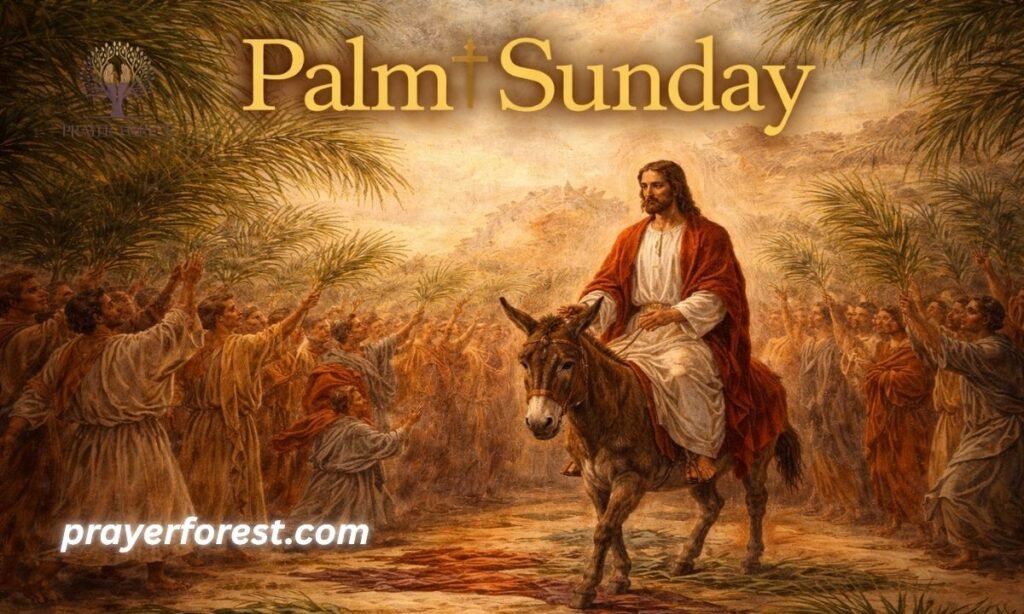
The story of Palm Sunday is recorded in all four Gospels — Matthew 21:1–11, Mark 11:1–10, Luke 19:28–44, and John 12:12–19 — making it one of the most comprehensively documented events in the New Testament. Each Gospel adds a different layer of meaning to the same powerful moment.
Matthew 21:1–11 — The Fulfillment of Prophecy
Matthew’s account focuses heavily on the fulfillment of Old Testament prophecy. Jesus instructs two disciples to bring a donkey and her colt from a nearby village, and Matthew explicitly links this to Zechariah 9:9: ‘Behold, your King is coming to you, humble, and mounted on a donkey.’
The crowd spreads garments and palm branches on the road, crying ‘Hosanna to the Son of David!’ When He enters Jerusalem, Matthew notes the entire city was ‘shaken’ — a word conveying deep agitation and turmoil.
Mark 11:1–10 — The Crowd’s Expectation
Mark’s version is vivid and immediate. The people laying garments and branches on the road echo the ancient welcoming of Jehu in the Hebrew Bible. The crowd praises Jesus as the one who brings the ‘kingdom of our father David.’ Mark captures both the excitement and the messianic expectation that had been building among the people of Israel for generations.
Luke 19:28–44 — Jesus Weeps Over Jerusalem
Luke adds a uniquely emotional dimension. As Jesus draws near to Jerusalem, He looks at the city and weeps — an event known in Latin as ‘Flevit super illam.’ He mourns over Jerusalem’s failure to recognize what brings peace. His tears reveal that beneath the triumphal procession was a heart broken for those who would not receive Him. This is not a distant or unmoved king — He enters with deep compassion.
John 12:12–19 — Palm Branches and Growing Belief
John is the only Gospel that specifically mentions palm branches (Greek: phoinix), which is why this day bears its name. John also notes that many in the crowd had witnessed the raising of Lazarus and came out because of it.
Meanwhile, the Pharisees observe the scene with alarm, noting that ‘the whole world has gone after him.’ John frames this as a turning point — the very public acclaim that accelerated the religious authorities’ plans to arrest Jesus.
The Meaning Behind Palm Sunday
Palm Sunday is not a single-layer story. It carries multiple, overlapping meanings — theological, historical, and personal — that have shaped Christian faith for over two thousand years.
A King Who Chooses Humility
In the ancient world, a king entering a city on a horse signaled war and conquest. A king arriving on a donkey signaled peace. Jesus’ deliberate choice of a donkey was a declaration of the kind of kingdom He was inaugurating — one not built on force or military power, but on love, service, and sacrifice. He was the Messiah, but not the kind of Messiah the crowd was hoping for.
‘Hosanna’ — What Did It Really Mean?
The crowd’s shout of ‘Hosanna’ (Hebrew: hoshi’a-na) was originally a desperate plea for help — ‘Save us now!’ Over time it evolved into a shout of joyful praise. On Palm Sunday, it carried both meanings simultaneously.
The people were praising Jesus while also crying out for rescue. That tension — celebration and need existing together — is at the heart of what Palm Sunday invites every believer to experience.
The Contrast of Triumph and Tragedy
What makes Palm Sunday uniquely powerful is its bittersweet nature. The same crowd that shouted ‘Hosanna!’ on Sunday would be shouting ‘Crucify Him!’ by Friday. Jesus enters Jerusalem fully aware of this. He does not correct the praise, nor does He retreat from Jerusalem.
He enters knowingly — carrying both the glory of the moment and the weight of what is coming. That willingness to walk into suffering for others is at the theological core of the Christian faith.
Why Palm Sunday 2026 Is Especially Significant?
In 2026, Palm Sunday falls on March 29, arriving at a moment when Christians worldwide are finishing the Fifth Week of Lent and stepping into Holy Week. For Catholic communities, this day is formally titled ‘Palm Sunday of the Passion of the Lord’ — combining the triumphal entry with a reading of the full Passion narrative of Jesus in the same liturgy.
This dual focus — triumph and passion, joy and grief — makes 2026’s Palm Sunday a spiritually rich threshold. The Church does not allow you to celebrate the entry without immediately confronting the cross. It is a full-picture day.
Notably, in 2026, the traditional Palm Sunday procession from the Mount of Olives to Jerusalem — where Jesus originally walked — was cancelled due to ongoing regional conflict. Churches around the world have been called by church leaders to hold a special moment of prayer for the Holy City on this day, adding a contemporary dimension of intercession to an ancient liturgical act.
Holy Week 2026 — Key Dates at a Glance
| Day | Date | Significance |
| Palm Sunday | March 29, 2026 | Triumphal entry of Jesus; Holy Week begins |
| Holy Monday | March 30, 2026 | Cleansing of the Temple |
| Holy Tuesday | March 31, 2026 | Jesus teaches in the Temple |
| Spy Wednesday | April 1, 2026 | Judas agrees to betray Jesus |
| Maundy Thursday | April 2, 2026 | Last Supper; washing of feet |
| Good Friday | April 3, 2026 | Crucifixion of Jesus Christ |
| Holy Saturday | April 4, 2026 | Jesus in the tomb; Easter Vigil |
| Easter Sunday | April 5, 2026 | Resurrection of Jesus Christ |
How Palm Sunday Is Observed Around the World?
Palm Sunday observances vary beautifully across Christian traditions, but they share common threads — the blessing of branches, scripture readings, and processions that reenact Jesus’ journey into Jerusalem.
Catholic and Anglican Traditions
In Catholic and Anglican churches, the service typically begins outside the church building or at the back of the nave. Blessed palms are distributed and the congregation processes into the sanctuary while singing hymns.
The Passion narrative is then read — often dramatically, with the congregation taking the role of the crowd. The liturgical color is red, symbolizing both the blood of Christ and the kingship of the Messiah.
Protestant Traditions
Protestant churches vary widely, but many include the distribution of palm branches, children’s palm processions, and detailed scripture readings from one or more of the four Gospel accounts. The focus is often on the theological meaning of the entry — Jesus as the peaceful king, the fulfillment of prophecy, and the beginning of His atoning work.
Eastern Orthodox Tradition
In Eastern Christianity, Palm Sunday (known as Entry of the Lord into Jerusalem) is celebrated one week after Western Palm Sunday in 2026, on April 5. The faithful bring home blessed willow or palm branches, which are kept in the icon corner as a blessing throughout the year. The Great Entrance of the Divine Liturgy carries special significance on this day, with worshippers standing holding their branches and lit candles.
Spiritual Lessons from Palm Sunday for Today
Palm Sunday is not only a liturgical event — it carries personal spiritual invitations for every believer.
• Receive Christ as He is, not as you expect Him to be. The crowd on Palm Sunday had their own idea of what the Messiah would do. Jesus fulfilled prophecy in a way they did not anticipate. Faith requires openness to God’s ways, which are often unexpected.
• Humility is not weakness. Jesus chose the donkey deliberately. The most powerful entrance was also the most humble. In a culture that prizes status and power, Palm Sunday calls us to a different vision of greatness.
• Praise can coexist with suffering. Jesus received the crowd’s praise while fully knowing the week ahead. We do not have to pretend everything is fine to worship. Bringing our real selves — our need, our gratitude, our fear — into prayer is exactly what ‘Hosanna’ modeled.
• Holy Week demands engagement. Palm Sunday is a beginning, not an ending. The Christian invitation is to follow Jesus through the full week — through betrayal, arrest, crucifixion, and into resurrection. You cannot get to Easter without going through Good Friday.
Conclusion
Palm Sunday 2026 is a day that bridges two worlds: the joyful world of praise and the sobering world of sacrifice. On March 29, as Christians across denominations wave palm branches, process through sanctuaries, and hear the Passion of Christ read aloud, they are participating in one of the oldest continuous acts of Christian worship in history.
The story of Jesus entering Jerusalem on a donkey, welcomed by crowds shouting ‘Hosanna,’ is not merely a historical memory. It is an ongoing invitation — to welcome the King of Peace into your own life, on His terms, with honest hands and an open heart. Whether this is your first Palm Sunday or your fiftieth, the meaning does not change. And neither does the King.
Holy Week has begun. The journey to Easter starts here.
Frequently Asked Questions
When is Palm Sunday 2026?
Palm Sunday 2026 falls on March 29, 2026 in Western Christianity, and April 5, 2026 for Eastern Orthodox Christians following the Julian calendar.
What do palm branches symbolize on Palm Sunday?
Palm branches symbolize victory, honor, and royal welcome — the crowd’s way of declaring Jesus as their long-awaited King and Messiah entering Jerusalem.
Why did Jesus ride on a donkey on Palm Sunday?
Donkeys symbolized peace in ancient Near Eastern culture, while horses symbolized war. Jesus’ choice fulfilled Zechariah 9:9 and declared that His kingdom is built on peace, not military conquest.
Which Gospels describe Palm Sunday?
All four canonical Gospels — Matthew 21, Mark 11, Luke 19, and John 12 — record Jesus’ triumphal entry into Jerusalem, making it one of the best-attested events in the New Testament.
What does ‘Hosanna’ mean?
‘Hosanna’ is a Hebrew expression meaning ‘save us now’ that evolved into a joyful shout of praise — the crowd simultaneously celebrated Jesus and pleaded for His salvation.
What is the liturgical color for Palm Sunday?
The liturgical color for Palm Sunday is red, representing both the blood of Christ’s Passion and the royal dignity of Christ as King.
How is Palm Sunday different from Easter Sunday?
Palm Sunday marks the beginning of Holy Week with Jesus’ entry into Jerusalem, while Easter Sunday celebrates His resurrection from the dead six days later.
Is the Palm Sunday procession in Jerusalem happening in 2026?
No — the traditional Palm Sunday procession from the Mount of Olives to Jerusalem has been cancelled in 2026 due to ongoing regional conflict, with church leaders calling for global prayer for the Holy City instead.

Robert Hugh Benson shares inspiring Bible verses and faith-filled reflections on Prayer Forest to guide readers toward peace, hope, and prayer.